Will I walk again? What actually shapes the outcome of gait rehabilitation
Published on
It is usually the first question asked after a stroke, a spinal cord injury or a serious brain injury, and often it is asked by a daughter or a husband rather than by the patient. Will I walk again. Will she walk again.
Nobody can answer that honestly from a distance, and you should be wary of anyone who tries. What can be said is which factors move the odds, what good gait rehabilitation looks like, and why the answer is far less fixed than it feels in the first weeks.
Why no one can give you a number
Two people with what looks like the same lesion on a scan can end up in very different places. The reason is that walking is not a single skill. It draws on trunk control, balance, the timing of muscle activation, the ability to shift weight onto a leg you may not feel properly, cardiovascular endurance, and confidence, which is not a soft factor at all.
A prognosis given in the first days after an event is a snapshot of a system still in acute upheaval. Swelling settles. Medication changes. Sleep improves. Assessment done a few weeks later frequently looks different from assessment done on day three.
This is why we do not give prognoses over the phone or by email. We assess.
The factors that genuinely matter
Some things are outside anyone’s control. The location and extent of the injury matters, and in spinal cord injury the completeness of the lesion matters a great deal. Age plays a part, though far less than people assume, and cardiovascular fitness before the event often explains more than the birth date does.
Whether you train the actual task. Strengthening a leg on a machine does not automatically produce walking. The nervous system learns what it practises. Walking improves mostly through walking, or through something that closely resembles it.
How many repetitions you get. This is the honest differentiator, and it is arithmetic rather than philosophy. A conventional session might deliver a few dozen assisted steps before the therapist and the patient are both exhausted. A robot-assisted session delivers hundreds to over a thousand, at a consistent quality, because the machine carries the weight and the therapist is free to correct the movement rather than support it. We have written separately about why dose drives outcome.
Whether you can start before you can stand. Body-weight support means gait training can begin when independent standing is still impossible. Waiting until someone can stand unaided before starting to train walking wastes the period in which the nervous system is most receptive.
What happens to the rest of your life. Spasticity, pain, poor sleep and low mood all quietly cap what a training session can achieve. They belong in the plan, not on a separate list.
Training walking when you cannot walk
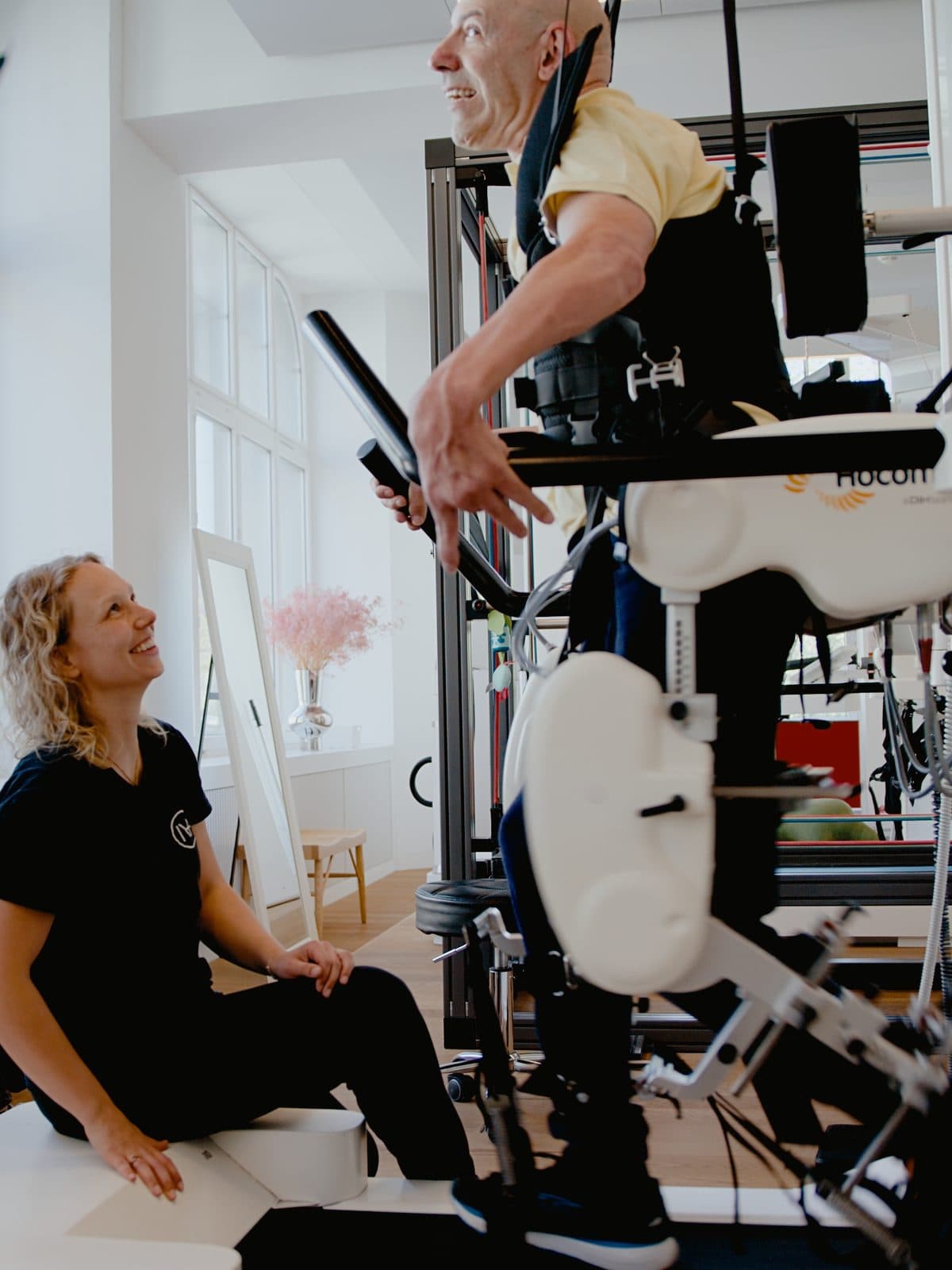
Patients are often surprised that gait training starts long before independent steps do. In a gait robot, the harness takes as much of your weight as you need, the legs are guided through a physiological pattern, and the support is reduced week by week as you take over more of it.
The point is not the machine. The point is that the correct movement pattern is repeated often enough, and accurately enough, for the nervous system to have something to learn from. Sensors record step symmetry, weight distribution and how much you contributed, which means progress is visible as numbers rather than as impressions. That matters when change is real but too small to feel.
A walking aid is not a failure
Plenty of people define success as walking without anything in their hands. It is worth loosening that definition a little. Walking two hundred metres with a stick, safely and without falling, changes daily life far more than a few unaided steps under supervision. Rehabilitation aims at the life you want to lead, and aids are part of how people get there.
Late is not too late
The steepest gains come early, which is why the first months should not be lost. But the nervous system does not close for business at six or twelve months. People who resume structured, sufficiently intense training years after a stroke or an injury still make measurable gains in walking speed and endurance. Slower than at the start, yes. Not absent.
If you are asking this question about yourself or about someone in your family, the useful next step is an assessment rather than an internet search. The initial assessment at our clinics in Zurich and St. Gallen is free, and you will leave it with an objective picture of where things stand and what training would look like. We will tell you what we see, including when we think the honest answer is a difficult one.
The next step
Talk to us about your situation.
In a free pre-assessment we discuss your medical history, your goals, and your insurance coverage options.
Book a consultation →