Why intensity determines therapy outcomes: understanding neuroplasticity
Published on
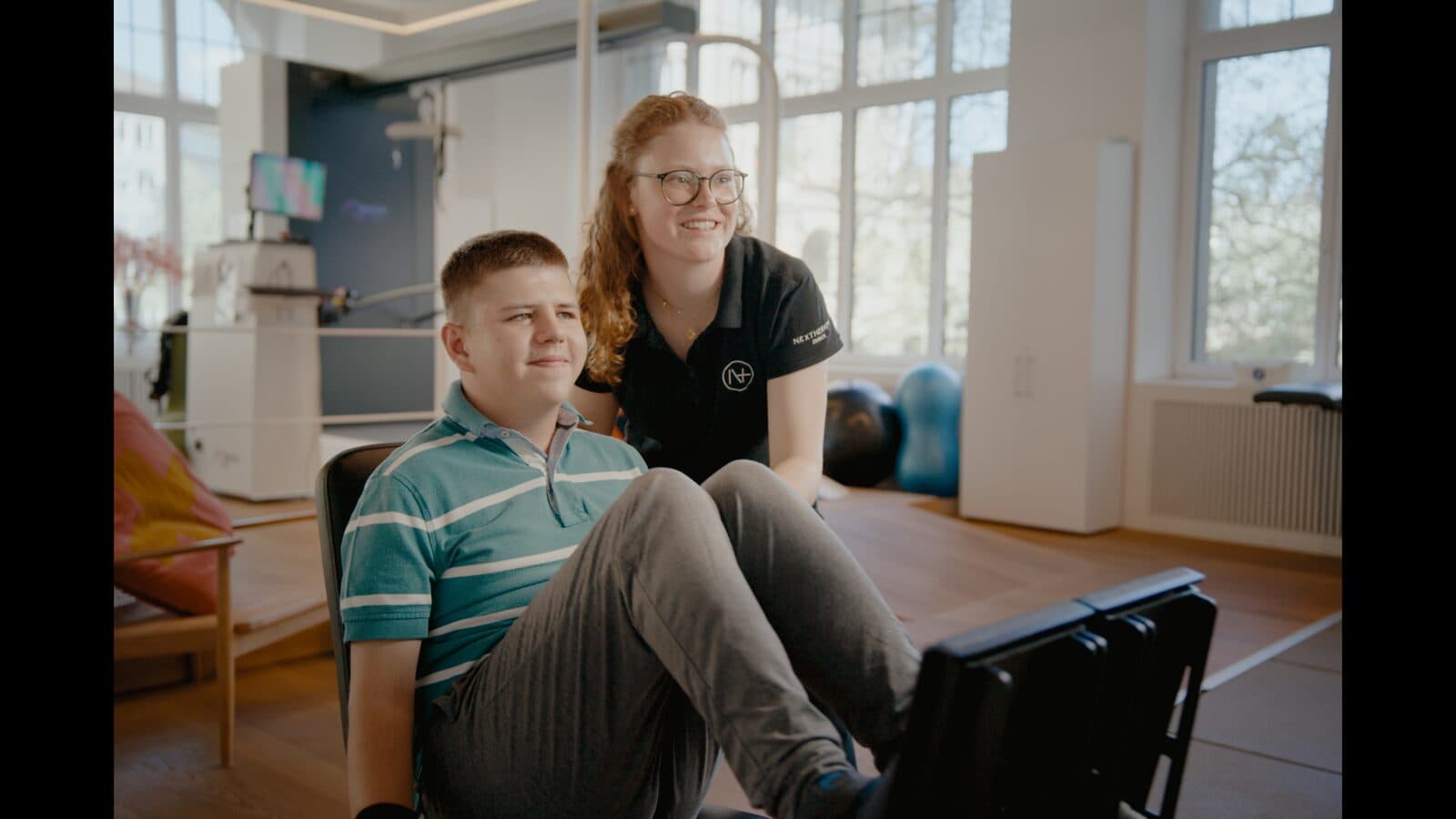
Anyone in rehabilitation after a stroke, a brain injury or with a progressive neurological condition will sooner or later hear a term that sounds abstract at first: neuroplasticity. Behind it lies one of the most important insights of modern neurorehabilitation, and it has very concrete consequences for how therapy should be structured if it is to work.
What neuroplasticity means
Neuroplasticity describes the nervous system's capacity to change structurally and functionally. After damage, whether from a stroke, a spinal cord injury or in the course of a condition such as multiple sclerosis or Parkinson's, surrounding areas of the brain or spinal cord can partly take over tasks previously performed by damaged tissue. New neural connections form and existing ones are strengthened. This process does not move in a good direction by itself. It has to be deliberately stimulated, and that happens through movement, through practice, through repetition.
Why the number of repetitions counts
Research into motor rehabilitation has shown a clear relationship for many years: the more often a movement is performed correctly, the more firmly the corresponding neural pattern consolidates. In animal models and clinical studies, several hundred to more than a thousand repetitions per training session have been described as necessary for a measurable motor learning effect, considerably more than can be achieved by hand in conventional one-to-one therapy. A therapist can guide a certain number of steps or grasping movements in a half-hour session. That number is limited by the physical capacity of the person delivering the treatment and by time, not by what would actually be useful for the brain.
This is precisely where robot-assisted therapy comes in. Systems that guide movements exactly, measure force and adjust support in real time make possible a multiple of the repetitions of a manual session, at consistent movement quality. In a single gait training session on the Lokomat, more than a thousand guided steps are achievable. This is not a replacement for the therapist but a tool that combines their clinical judgement with an intensity that would be unreachable by hand.
Not only how often, but how correctly
Repetition alone is not enough. What matters is that the movement is performed at a quality that genuinely reinforces the desired pattern, and that the task remains challenging enough to prompt the nervous system to learn. Too easy, and too little happens. Too hard, and the movement is compensated for rather than correctly learned. Our robot-assisted systems therefore adjust support continuously to the actual level of performance: as much help as necessary, as little as possible. This fine calibration demands just as much clinical experience as manual therapy itself, only by different means.
Why dose determines what happens over time
Neuroplasticity is also time-dependent. In the first weeks and months after acute damage, such as a stroke, the nervous system is particularly receptive to change. Training with sufficient intensity in this phase makes deliberate use of that window. But the principle holds for chronic and progressive conditions such as multiple sclerosis and Parkinson's too: regular, sufficiently intensive training preserves functions that would otherwise be lost more quickly. At Nextherapy we therefore often recommend several therapy sessions per week over a longer period rather than isolated appointments. It is the sum of practice time across weeks and months that makes the difference.
What this means for your therapy
For patients and their families this yields a simple but important question worth asking: how many repetitions and how much active practice time do I actually achieve in a session? The answer often says more about the progress to expect than the number of appointments alone. At Nextherapy we document every session with data, so that intensity and progress remain transparent for you and your treatment team at all times.
If you would like to find out what an intensity-focused therapy programme could look like for your situation or your child's, we are glad to begin with a free pre-assessment in Zürich or St. Gallen. There we will discuss your starting point, your goals and the options for cost coverage.
The next step
Talk to us about your situation.
In a free pre-assessment we discuss your medical history, your goals, and your insurance coverage options.
Book a consultation →