Cerebral palsy in children: how robot-assisted therapy with the Lokomat Pediatric supports development
Published on
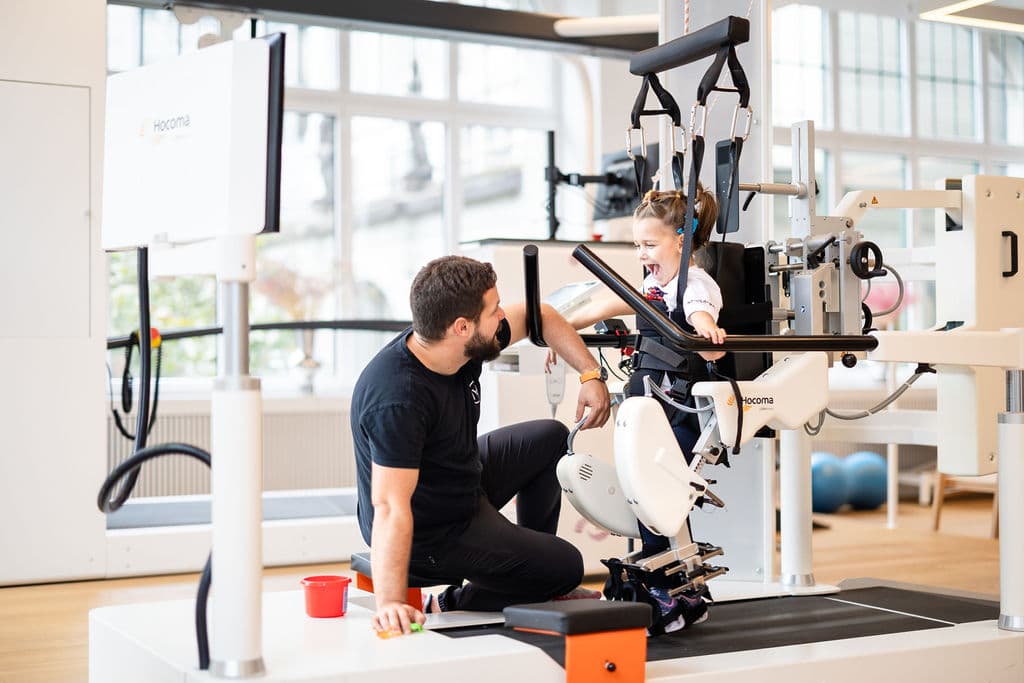
When a child is diagnosed with cerebral palsy, one question matters most to parents: how much movement ability can still develop, and what can we do about it. Cerebral palsy arises from an injury to the brain in early childhood and affects posture and movement to varying degrees, from mild unsteadiness in walking to pronounced motor limitations. What applies to every child, however, is the same principle: the developing brain is especially adaptable, and targeted, repeated practice can strengthen and establish motor pathways, even over a span of years.
What cerebral palsy means for gait training
Many children with cerebral palsy have increased muscle tone, unsteady balance or an atypical gait pattern. Conventional gait training by hand is often strenuous and limited in time, because a therapist can manually guide and stabilise a child for only a finite number of steps before their own strength gives out. This is precisely where robot-assisted training comes in: it takes over the guidance and securing of the movement, so that the child can practise considerably more steps per session than would be possible by hand.
The Lokomat Pediatric in detail
The Lokomat Pediatric is a version of the robot-assisted gait trainer developed specifically for children, adapted to smaller body sizes and the particular needs of young patients. The child is secured into a walking system above a treadmill while leg orthoses guide the stepping movement and adjust precisely to the individual gait pattern. Exercises are additionally presented as games on a screen, which sustains motivation across a whole session, particularly with younger children. At the same time the system continuously records data on step length, loading and symmetry, making the course of progress objectively visible.
Why repetition is especially effective in children
Research on neuroplasticity shows that motor learning depends on the volume of correctly executed repetitions, and this effect is especially pronounced in children because their nervous system is still actively developing. A child who practises several hundred guided steps in a session rather than a few dozen simply has more opportunities to rehearse a more stable gait pattern. What matters is that the movement is performed correctly and without compensatory patterns, which the robotics ensure through precise guidance while our therapists accompany the session and adjust it as it goes.
A further advantage lies in the measurability of progress. Because each session produces data on step count, symmetry and loading, development can be traced objectively over weeks and months rather than relying on the subjective impression of a single hour of practice. For parents this means clarity about whether and how the therapy is working, and for our team it provides the basis for adjusting the training deliberately, for instance when a child is ready for longer distances or more demanding surfaces.
How a therapy session at Nextherapy works
Every course of treatment begins with a careful assessment of gait pattern, muscle tone and mobility by our paediatric therapy team. Building on this, an individual training plan is created that combines sessions on the Lokomat Pediatric with conventional physiotherapy and, where necessary, occupational therapy. Sessions are structured appropriately for children, with clear goals and sufficient breaks, and are adapted to the child's progress throughout the treatment. Parents are involved continuously and kept informed about how their child is developing.
Costs and access for families
For children with cerebral palsy, disability insurance (IV) generally covers the cost of outpatient therapy, provided a medical prescription is in place. At Nextherapy we arrange the cost approval directly with the IV and bill the use of our robotic systems, including the Lokomat Pediatric, without additional charges for the family. For us the technology is part of the regular therapy programme, not a separately invoiced extra.
For many families the question of reliability over a longer period is also decisive, since progress in cerebral palsy rarely becomes visible overnight and instead builds over months and years. We therefore place value on consistent key contacts within the therapy team and regular review meetings, so that parents always know where their child stands and which next steps make sense.
If you are considering outpatient therapy for your child in Zürich or St. Gallen, we invite you to a free pre-assessment. Together we will discuss where things stand, possible therapy goals and any questions about cost coverage, with no obligation.
The next step
Talk to us about your situation.
In a free pre-assessment we discuss your medical history, your goals, and your insurance coverage options.
Book a consultation →