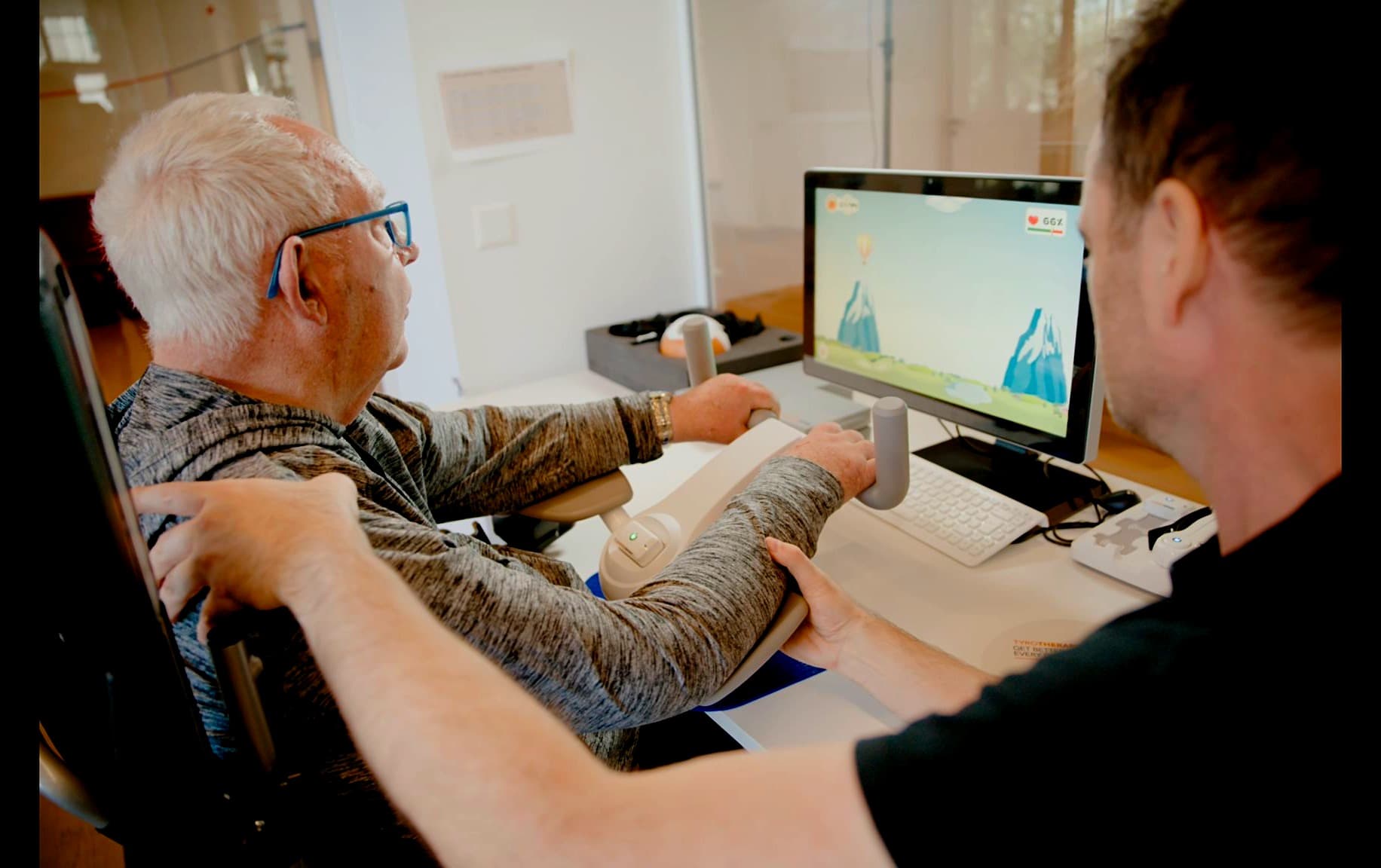
A stroke changes from one moment to the next what had been taken for granted: walking, grasping, speaking. For those affected and their families, the question quickly becomes what happens now and how much recovery is actually possible. The first year after the event plays a particular role, because it is the phase in which the brain is most adaptable and in which the right therapy makes the greatest difference.
The acute phase and the first weeks
Immediately after a stroke the priority is medical stabilisation, usually in hospital and often followed by inpatient rehabilitation. Therapy generally begins in this early phase, as soon as the person's condition allows. Physiotherapy, occupational therapy and, where needed, speech therapy start work on restoring lost functions as quickly as possible. How pronounced the deficits are depends heavily on which region of the brain was affected and how quickly treatment began.
Why the first months are especially valuable for the brain
After a stroke the brain passes through a phase of heightened neuroplasticity, in which nerve connections can form and adapt with particular vigour. This phase is most pronounced in the first three to six months and diminishes gradually thereafter, without disappearing entirely. That is precisely why what counts in this period is less how much patience a person can muster and more how many targeted, correctly executed repetitions they can actually train. Studies show repeatedly that the volume of active, task-specific practice is one of the most important factors in the extent of recovery.
The transition from clinic back to everyday life
Recovery does not end when inpatient rehabilitation does, even though many patients initially fear it will. The move home is a critical moment: the density of therapy often drops abruptly, while daily life simultaneously imposes new demands, from climbing stairs to dressing independently. Well-planned outpatient follow-up closes this gap and ensures that the progress achieved in the clinic is consolidated and built upon rather than lost.
Why intensity makes the difference in outpatient care too
Many people underestimate how much practice is needed to perform a single everyday movement, such as reaching for a cup, reliably again. Conventional one-to-one therapy is limited by time: a therapist can offer only a finite number of guided repetitions in a session before the hour runs out. Robot-assisted systems such as the Lokomat for walking, or Amadeo and Pablo for the arm and hand, enable considerably more repetitions per session, with precise control of load and objective measurement of progress. This allows a training intensity that would be hard to reach by hand alone, without overtaxing the patient.
What the course of the first year can look like
In the first months the focus is often on fundamental function: standing, walking, grasping. Over time the emphasis shifts increasingly towards fine motor skills, endurance, balance in more complex situations, and the return to activities that were self-evident before the stroke, whether work, a hobby or social participation. A data-driven approach makes this progression visible: every session is recorded, so that progress is objectively traceable and therapy can be adjusted continuously to actual development rather than following a rigid scheme.
How support at Nextherapy works
At Nextherapy every course of outpatient treatment begins with a thorough initial assessment in which we establish the current state of strength, mobility and everyday function. Building on this, our physiotherapists and occupational therapists create an individual programme that combines robot-assisted training with conventional therapy and is adapted throughout the treatment. The use of our technologies incurs no additional costs: it is part of the regular therapy programme and is billed through your health, disability, accident or military insurance.
If you or a family member is in the outpatient phase of rehabilitation after a stroke, we invite you to a free pre-assessment in Zürich or St. Gallen. Together we will discuss where things stand, what goals are possible and any questions about cost coverage, with no obligation.
The next step
Talk to us about your situation.
In a free pre-assessment we discuss your medical history, your goals, and your insurance coverage options.
Book a consultation →